
 📖 peek inside
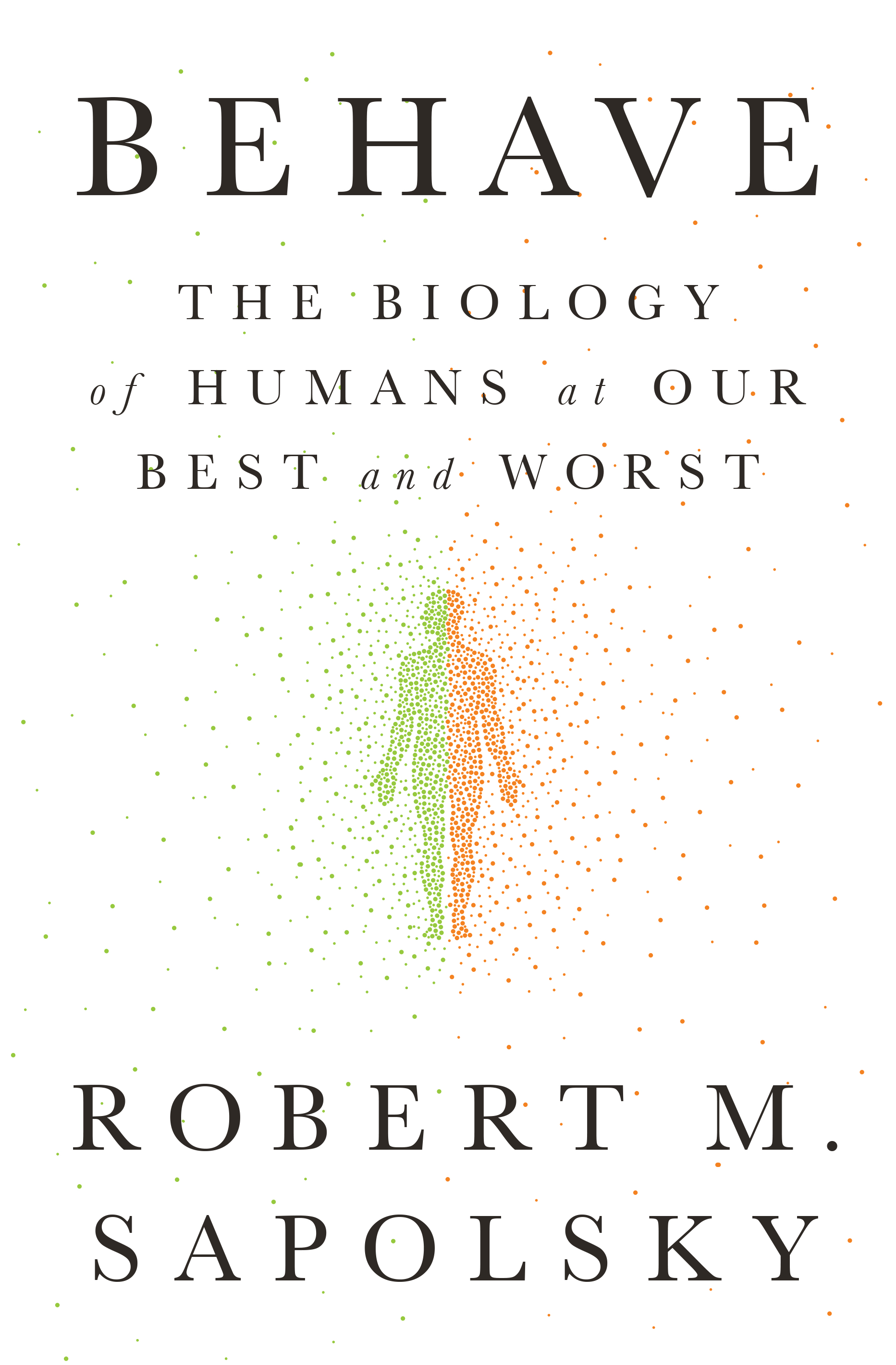
Behave: The Biology of Humans at Our Best and Worst
by Robert Sapolsky
Robert Sapolsky provides a monumental examination of human behavior, seeking to explain why we do the things we do. He traces the causes of an action from the seconds before it happens back through millions of years of evolution. By synthesizing neurobiology, endocrinology, and genetics, Sapolsky explores the roots of tribalism, xenophobia, and altruism. It is a profound and witty investigation into the biological factors that drive our most noble and most destructive impulses, offering deep insights into the human condition.
A popular book with millions of readers worldwide.
Notable Quotes
"You don’t have to choose between being scientific and being compassionate."
"The brain is heavily influenced by genes. But from birth through young adulthood, the part of the human brain that most defines us (frontal cortex) is less a product of the genes with which you started life than of what life has thrown at you. Because it is the last to mature, by definition the frontal cortex is the brain region least constrained by genes and most sculpted by experience. This must be so, to be the supremely complex social species that we are. Ironically, it seems that the genetic program of human brain development has evolved to, as much as possible, free the frontal cortex from genes."
"Why should people in one part of the globe have developed collectivist cultures, while others went individualist? The United States is the individualism poster child for at least two reasons. First there's immigration. Currently, 12 percent of Americans are immigrants, another 12 percent are children of immigrants, and everyone else except for the 0.9 percent pure Native Americans descend from people who emigrated within the last five hundred years. And who were the immigrants? Those in the settled world who were cranks, malcontents, restless, heretical, black sheep, hyperactive, hypomanic, misanthropic, itchy, unconventional, yearning to be rich, yearning to be out of their damn boring repressive little hamlet, yearning. Couple that with the second reason - for the majority of its colonial and independent history, America has had a moving frontier luring those whose extreme prickly optimism made merely booking passage to the New World insufficiently novel - and you've got America the individualistic. Why has East Asia provided textbook examples of collectivism? The key is how culture is shaped by the way people traditionally made a living, which in turn is shaped by ecology. And in East Asia it's all about rice. Rice, which was domesticated there roughly ten thousand years ago, requires massive amounts of communal work. Not just backbreaking planting and harvesting, which are done in rotation because the entire village is needed to harvest each family's rice. The United States was not without labor-intensive agriculture historically. But rather than solving that with collectivism, it solved it withe slavery."
You might also enjoy

The Body Keeps the Score
by Bessel van der Kolk
A dense, pioneering psychiatric study on trauma. It offers scientifically validated methods to heal your nervous system.

Influence: The Psychology of Persuasion
by Robert B. Cialdini
The definitive, academically rigorous guide to persuasion. It scientifically breaks down how to ethically influence human behavior.
Thinking, Fast and Slow
by Daniel Kahneman
A Nobel laureate explores how the human mind works. Highly academic, research-backed, and fundamentally changes your perspective.
Why We Sleep: Unlocking the Power of Sleep and Dreams
by Matthew Walker
A comprehensive, research-heavy dive into sleep science. It explains the profound neurological impacts of rest on our bodies.

Noise: A Flaw in Human Judgment
by Daniel Kahneman, Olivier Sibony, and Cass R. Sunstein
A rigorous statistical look at why human judgment fails. It provides an academic framework for making better, unbiased decisions.

Thinking in Bets
by Annie Duke
A poker champion applies behavioral science to decision-making. Delivers actionable strategies for navigating uncertainty and risk.